About this Journal
The Theodore Roosevelt Association Journal, established in 1975 by Dr. John Allen Gable and edited by him through 2004, is a peer-reviewed periodical. The Theodore Roosevelt Association is a national historical society and public service organization founded in 1919 and chartered by a special act of Congress in 1920. We are a not-for-profit corporation of the District of Columbia, with offices in New York State.
The Theodore Roosevelt Association Journal is published quarterly by the:
Theodore Roosevelt Association
www.theodoreroosevelt.org
P.O. Box 719
Oyster Bay, NY 11771
Editorial Board:President, David Architzel
Director Emeritus: Hermann Hagedorn (1919-1957)
Director Emeritus: Dr. John A. Gable (1974-2005)
Editor of the Journal: Dr. William N. Tilchin
Journal Designer: Mary Ann Rosson
Current Issue
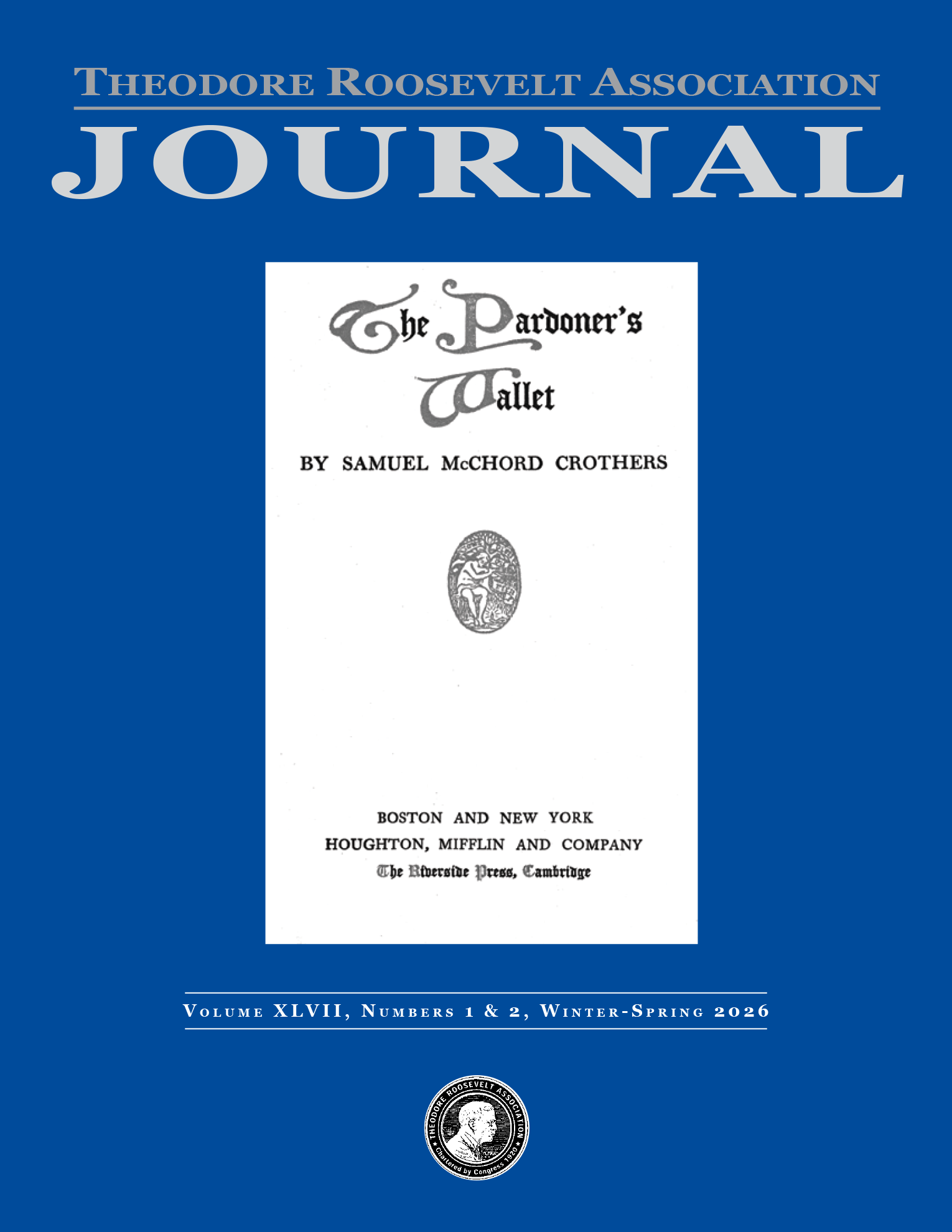 Volume XLVII, Numbers 1 & 2, Winter-Spring 2026
- Theodore Roosevelt: Global Citizen in the Arena by Michael Patrick Cullinane - pages 12-24
- THE THEODORE ROOSEVELT ASSOCIATION JOURNAL’S MEMORIAL TRIBUTE TO WALLACE FINLEY DAILEY - pages 26-37
- My Friend Wallace by Kathleen Dalton - pages 27-28
- The Theodore Roosevelt Sesquicentennial at Harvard University by Wallace Finley Dailey - pages 29-31
- The Theodore Roosevelt Collection at Harvard: A Sixty-ninth Anniversary Report and Farewell Curatorial Summary by Wallace Finley Dailey - pages 32-37
- Theodore Roosevelt’s Centrality to the Portsmouth Treaty by William Tilchin - pages 38-43
- Mystery, Melancholy, and Charm: A Review of Paul Schullery, ed., Theodore Roosevelt’s Wilderness Writings by Duane G. Jundt - pages 44-50
- Presidential Snapshot #52 - page 51
- TRA Police and Military Member William Stump Profiles in Uniform #1A by Edward Scali, Jr. - pages 52-53
- The Theodore Roosevelt Association’s 106th Annual Meeting in Hyde Park, New York by Chris Cosentino - pages 54-63
- Introduction of Theodore Roosevelt Distinguished Service Medal Recipients Ivan Schwartz and StudioEIS by Gregory A. Wynn - pages 64-66
- Sculpting on History’s Coattails by Ivan Schwartz - pages 67-73
Notes from the Editor
first met Wallace Finley Dailey, the recently deceased longtime curator of the Theodore Roosevelt Collection, at a TR quasquicentennial event at Harvard University in December 1983 (where I also had my first in-person encounter with Dr. John Gable). Probably the real beginning of my friendship with Wallace occurred during the outstanding TR conference at Hofstra University in April 1990, as he and I spoke briefly between some of the sessions and then sat together for the celebratory dinner. Afterwards, I saw Wallace again several times as I was conducting research for my Brown University dissertation and subsequently for my book Theodore Roosevelt and the British Empire: A Study in Presidential Statecraft, and at some TRA Annual Meetings as well. I always enjoyed his company, and the feeling appeared to be mutual.
A higher-level friendship between Wallace and me developed during the period 2007-2012, my first six years as editor of the Theodore Roosevelt Association Journal and Wallace’s final six years as curator of the TR Collection. For every single issue of the TRA Journal, I scheduled a morning appointment with Wallace and then traveled by local train from Boston University to Harvard to meet with him for about two hours. Wallace was my essential adviser on images— and supplier of images—for those issues. His extraordinary knowledge of the contents of the TR Collection and the location of various photographs invariably made our meetings enjoyable, efficient, and extremely fruitful for me. Following these meetings, which usually concluded sometime around noon, I would reward Wallace (and myself) by taking him out for lunch. My records validate my memory by showing that from 2007 to 2011 we regularly went to a Cambridge restaurant called Grafton Street, a favorite of Wallace, where the atmosphere was pleasant and the food was excellent and reasonably priced. (So the impact on the TRA Journal expenses account was minor, with the total cost of lunch for two, including tip, ranging from $20 to $38.) In addition, during those years I visited with Wallace when I came to Harvard to see exhibits he had created and to attend events he had organized. During that same period Wallace also contributed directly several times to the Theodore Roosevelt Association Journal, most notably when the TRA Journal featured two of his exhibits (Part One and Part Two of “The Education of Theodore Roosevelt”: “The Harvard Years: Theodore Roosevelt, Class of 1880,” in Vol. XXXIII, Nos. 1, 2, & 3, Winter-Spring-Summer 2012, pp. 7-46; and “Roosevelt Reading: The Pigskin Library, 1909-1910,” in Vol. XXXIV, Nos. 1, 2, & 3, Winter-Spring-Summer 2013, pp. 7-34). Two of Wallace’s TRA Journal articles are republished in this edition on pages 29-31 and 32-37.
After Wallace’s retirement from Harvard—as he carried on with his other important job as an archivist for Massachusetts— he remained a member of the TRA Advisory Board, and he and I were in contact from time to time. He very generously gave me as a gift a rare book (see the back cover of this issue) that became the basis for an article in the Fall 2013 TRA Journal. On occasion he would comment on articles in the TRA Journal that he particularly liked. Moreover, he became one of only a few TRA members who furnished financial support for the TRA Journal digitization project, of which he wholeheartedly approved.
Wallace, who had received the Bertha Benkard Rose Award for outstanding service to the Theodore Roosevelt Association in 1996, continued to provide valuable services to the TRA until the end of his life. And on a much larger platform, of course, over several decades he had been a vital participant in many dozens of TR and TR-related scholarly, literary, and filmmaking projects.
I considered Wallace Dailey to be a good friend. Beyond his exceptional helpfulness, he was a very nice person, and I will always remember him very fondly. May he rest in peace.
William Tilchin